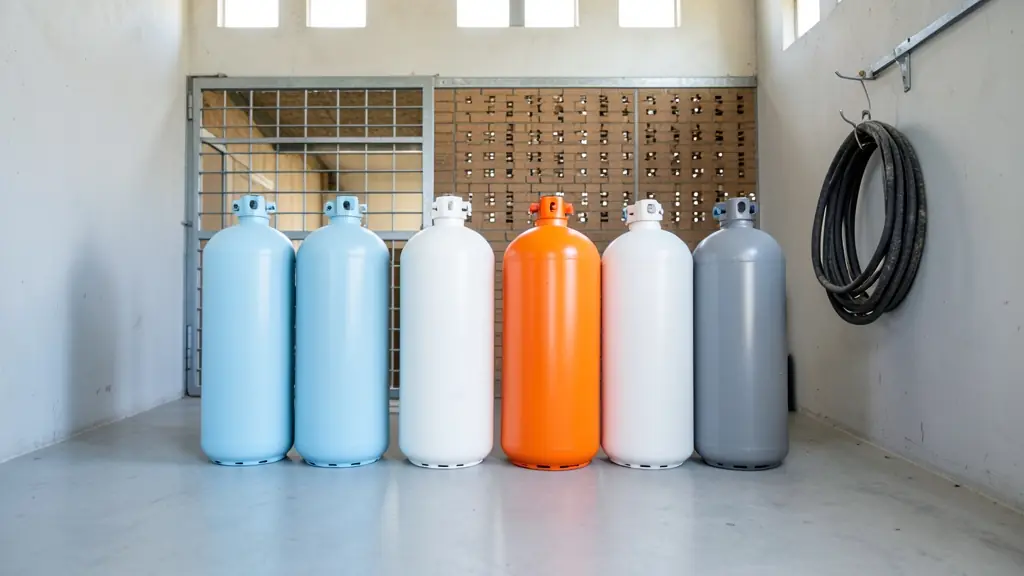
Every fridge, freezer and cold room runs on a refrigerant, and the gas decides who can work on it, which parts and gauges they need, and what it does to the climate if it leaks. Choose a gas and put in the charge from the rating plate to see its CO₂ equivalent, its safety class and where it is used.
TL-08Refrigerants at a glance
GWP is the global warming potential over 100 years compared with carbon dioxide (IPCC AR4 values, the ones the Kigali Amendment uses). The safety class follows ASHRAE 34 and ISO 817: A is lower toxicity and B higher; 1 is not flammable, 2L mildly flammable and 3 highly flammable.
| Gas | GWP | Class | Boils at | Used in |
|---|---|---|---|---|
| R600a | 3 | A3 | -11.7 °C | Most household fridges and freezers made since about 2010 |
| R290 | 3 | A3 | -42.1 °C | Bottle coolers, display fridges, ice cream freezers and some heat pumps and aircons |
| R134a | 1430 | A1 | -26.1 °C | Many older household fridges, car aircons and medium temperature commercial units |
| R404A | 3922 | A1 | -46.5 °C | Cold rooms, freezer rooms, display freezers and transport refrigeration |
| R507A | 3985 | A1 | -46.7 °C | Low temperature cold rooms and freezers, similar to R404A |
| R448A | 1387 | A1 | -45.9 °C | A lower GWP replacement for R404A in cold rooms and supermarkets |
| R449A | 1397 | A1 | -46.0 °C | A lower GWP replacement for R404A in cold rooms and supermarkets |
| R452A | 2140 | A1 | -47.0 °C | Transport refrigeration and condensing units, replacing R404A |
| R22 | 1810 | A1 | -40.8 °C | Old aircons and older cold rooms |
| R410A | 2088 | A1 | -51.4 °C | Split aircons and heat pumps |
| R32 | 675 | A2L | -51.7 °C | Newer split aircons and heat pumps |
| R744 | 1 | A1 | -78.5 (sublimes) °C | Supermarket systems, some bottle coolers and heat pumps |
| R717 | 0 | B2L | -33.3 °C | Large industrial cold stores, abattoirs and food plants |
Which gas is in my fridge?
Look at the rating plate inside the fridge or on the back: it names the refrigerant and the charge in grams. Most household fridges made since about 2010 use R600a, many older ones R134a, and fridges from before the mid 1990s often used R12, which is now banned. Shop coolers increasingly use R290, and cold rooms R404A or its lower GWP replacements.
A fridge must be recharged with the gas it was built for. Mixing gases or "topping up" with another one damages the compressor and voids any guarantee. See fridge gas for cylinder prices and fridge gas refill for regassing.
Working safely with refrigerants
- Leave it to a qualified technician. Refrigerant work needs the right gauges, a vacuum pump and recovery equipment, and the training for the gas.
- Hydrocarbons are flammable. R600a and R290 systems must be recovered and purged before any brazing, in a ventilated space, with no ignition sources.
- Never vent gas. Recover it into a recovery cylinder: it is better for the climate and the ozone layer, and it is required practice.
- Fix the leak first. A system that needs gas has a leak. A regas without a leak repair rarely lasts.