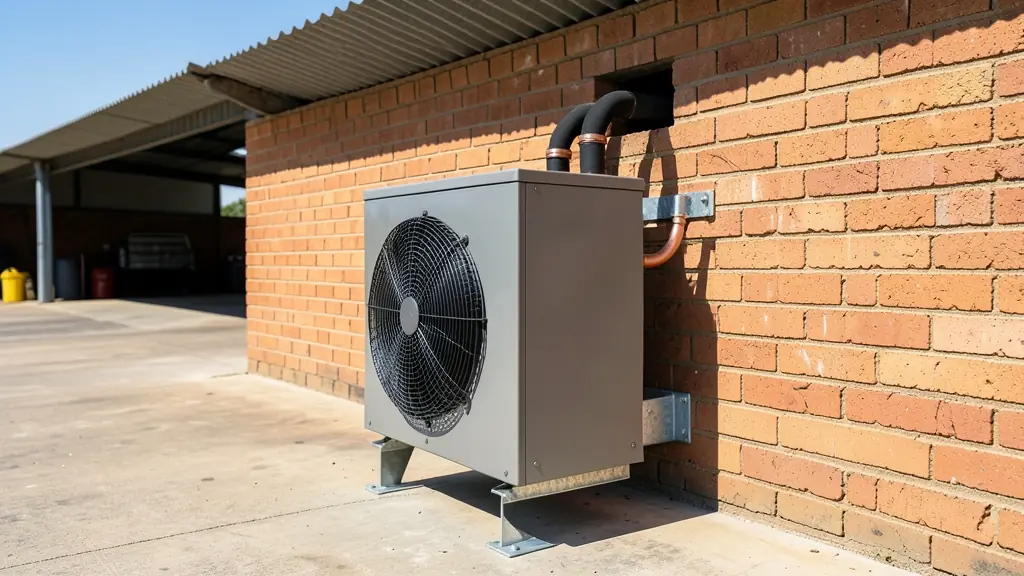
When businesses search for compressors refrigeration suppliers for a cold room, what they usually need is a condensing unit: a compressor, a condenser coil and a fan in one casing, usually outside. Inside the room, an evaporator with its own fans takes out the heat. Getting the pair right for the room size, temperature, gas and climate decides how well the room holds and how hard the machine works. Send the room size, the temperature you need and what you store, and suppliers and installers near you quote. It is free and you are not bound to any quote.
How a cold room system is sized
A condensing unit is chosen on the heat it has to remove, not on the room size alone. The installer looks at:
- The room's inside dimensions and panel thickness.
- The target temperature: a chiller at a few degrees above zero, or a freezer room around -18 °C or colder.
- What goes in, how much each day and how warm it is when it arrives.
- How often the door opens.
- Where the unit will sit: full sun, a hot roof or a shaded wall.
An undersized unit runs non-stop and still cannot hold the room. An oversized one short-cycles. For the room itself, see cold rooms.
Choices to discuss
Refrigerant choice matters for the life of the system; ask which gas the unit uses and how easy it is to get. Single-phase units suit smaller rooms; larger systems often need three-phase power, so check what the DB board can supply. Ask about the temperature controller and alarm, the defrost method on freezer rooms and whether the condenser has room to breathe. Salt air near the coast and dust inland both clog condenser coils, so plan access for cleaning. Ask each supplier for the unit's rated capacity at your room temperature and a summer outdoor temperature, so you can compare like with like rather than horsepower alone.
What drives the price
As a guide, a cold room cooling system, meaning the condensing unit and evaporator together, is about R23,000 to R60,000 depending on size, temperature and gas. Installation is often about R8,000 to R25,000 on top, covering copper pipe runs, wiring, drains, vacuum and charging. Long pipe runs, roof mounting and three-phase supply add to the cost. Second-hand units are quoted per item; ask that they are pressure tested and that you know the gas.
Keeping a unit healthy
Most cold room breakdowns start small: a dirty condenser, a failed fan, an iced evaporator or a slow leak. A regular service, with coils cleaned, pressures checked and the defrost tested, catches these early. Keep a daily temperature log, which food businesses need anyway. A surge protector or phase protection helps through power cuts and load-shedding. Check that the evaporator drain line is clear and, on freezer rooms, that its heater works, or ice will creep back into the room. For breakdowns, see cold room repairs.
What to include in your request
- Room inside size and panel thickness
- Target temperature and what is stored
- Single-phase or three-phase power on site
- Where the outdoor unit can go
- Supply only, or supply and install
Condensing Units for different clients
- Households: a small chiller unit for a home business baking or catering from the garage
- Landlords, guest houses and B&Bs: a condensing unit for a guest lodge's walk-in cold room
- Shops, cafes and supermarkets: a remote condensing unit for a supermarket or butchery cold room
- Restaurants, butcheries and caterers: a condensing unit and evaporator for a restaurant walk-in chiller
- Farms, packhouses and dairies: units for packhouse and dairy cold rooms that run through harvest
- Factories and cold stores: larger three-phase systems for cold stores and distribution depots
- Schools, clinics and public buildings: a replacement unit for a hospital kitchen or school feeding scheme cold room
- Technicians and repairers: units supplied to contractors installing cold rooms for clients
Frequently asked questions
How much is a cold room compressor?
What is the difference between a compressor and a condensing unit?
Can I reuse my old evaporator with a new condensing unit?
Who quotes when I send the form?
Condensing Units by province and city
- Johannesburg
- Pretoria
- Centurion
- Midrand
- Sandton
- Randburg
- Roodepoort
- Krugersdorp
- Randfontein
- Germiston
- Boksburg
- Benoni
- Kempton Park
- Alberton
- Vanderbijlpark
- Vereeniging
- Durban
- Pinetown
- Pietermaritzburg
- Richards Bay
- Newcastle
- Ladysmith
- Gqeberha (Port Elizabeth)
- East London
- Kariega (Uitenhage)
- Mthatha
- Cape Town
- Bellville
- Paarl
- Stellenbosch
- George
- Worcester
- eMalahleni (Witbank)
- Middelburg
- Secunda
- Mbombela (Nelspruit)
- Rustenburg
- Brits
- Klerksdorp
- Potchefstroom
- Mahikeng
- Polokwane
- Tzaneen
- Kimberley
- Upington
- Bloemfontein
- Welkom
- Sasolburg