
Common Air Conditioner Issues That Require Repair
Insufficient Cooling and Airflow Problems
South African summers punish air conditioners, and most cooling failures follow a predictable pattern. When the unit runs but delivers lukewarm air, insufficient refrigerant or a failing start capacitor is often the culprit. Insufficient cooling forces the compressor to labour continuously, which drives up energy costs.
Airflow problems show up as weak output or uneven cooling between rooms. When we inspect failing units, blocked filters top the list. Check these components:
- Clogged filters that restrict circulation
- Dirty evaporator coils that reduce heat absorption
- Failing fan motors that weaken air delivery
These faults also destabilise the electrical draw. Overworked components accelerate wear, and a neglected unit may fail entirely during a heatwave. Professional air conditioner and fridge repair extends equipment life and restores consistent performance.
Refrigerant Leaks and Their Impact on Efficiency
Refrigerant leaks rarely announce themselves. They develop in silence, hidden within the coil, slowly draining the system of its ability to transfer heat. Pressures drop, the compressor strains, and efficiency decays with each passing cycle. Energy usage climbs while cooling output falters, a slow decline that often goes unnoticed until the unit fails outright.
This hidden loss affects more than comfort. Oil can escape alongside the refrigerant, compromising lubrication and accelerating wear on internal parts. Some systems develop ice on the evaporator, while others emit a faint hiss near the seams.
- Frost along the copper lines
- Persistent odour from the vents
- Cycling on and off without reaching temperature
Early detection prevents costly damage. Professional air conditioner and fridge repair restores the sealed circuit and returns the system to efficient operation.
Faulty Thermostat and Electrical Component Failures
Electrical faults are responsible for roughly a third of unexpected cooling shutdowns. A thermostat can read the room perfectly yet never send the signal to start. Capacitors lose their charge, relays weld shut, and contactors buzz until they burn out! In South Africa, voltage fluctuations from grid instability accelerate this wear, turning small issues into complete breakdowns.
- A thermostat that requires repeated adjustments to reach the set point
- A condenser that hums but does not kick on
- Intermittent cooling that lasts only minutes
A technician will measure capacitance, check relays, and verify wiring integrity. In my experience, these parts are cheap to replace if caught early. Delaying only invites a larger expense. Professional air conditioner and fridge repair addresses these electrical ailments with precision.
Strange Noises and Odors From the Unit
A compressor that rattles like a tin can never means well. The air conditioner labours, and you notice the sound comes in waves. Odors follow with equal stubbornness. A musty smell points to moisture trapped in the drain pan, where mould settles. A sharp chemical scent can indicate a failing motor winding.
I have walked into many homes where the owner simply turned up the volume to ignore these signs. That is the wrong move! Strange noises and odors are the unit’s way of speaking before it breaks.
- A loose fan blade tapping the housing
- A worn bearing grinding on start-up
- A refrigerant line vibrating against the frame
Each issue needs a technician’s hands, not a remote control. Professional air conditioner and fridge repair stops these hidden problems from interrupting your sleep or your family’s comfort.
Water Leaks and Drainage System Clogs
Water pooling beneath an air conditioner often signals a blocked condensate drain. The evaporator coil sweats moisture onto the drain pan. When dust and debris clog the line, water backs up and spills over. I have seen ceilings stained brown from units mounted too high, the water tracing a slow path through paint and plaster. A fridge with a clogged defrost drain collects water beneath crisper drawers, where it freezes into a stubborn sheet.
Some clogs require simple attention:
- A drain line pinched behind the cabinet
- Algae growth inside the condensate hose
- A misaligned drain pan tipping water sideways
Professional air conditioner and fridge repair addresses these drainage failures before moisture reaches electrical components, where water becomes a different problem entirely.
Frequent Refrigerator Malfunctions and Repair Solutions
Temperature Fluctuations and Inconsistent Cooling
A refrigerator that cannot hold a steady temperature becomes a source of quiet anxiety. Every open door brings a gamble. The milk might be fine, or it might turn. This inconsistency often stems from a defective thermistor, a failing defrost heater, or a worn door gasket.
In my repair experience, the root cause hides behind the rear panel. When frost accumulates on the evaporator coils, airflow drops and temperatures swing wildly. The compressor keeps running, but the cold never reaches the shelves. That is why air conditioner and fridge repair professionals in South Africa inspect the entire cooling loop, not just the obvious components.
- A stuck defrost timer
- A misaligned door hinge
- A failing temperature sensor
Ignoring these fluctuations forces the system to overwork, accelerating wear on the compressor and raising electricity consumption.
Broken Compressor and Condenser Coil Issues
A compressor that fails is rarely a sudden event. It is a progression. The condenser coil, usually tucked beneath or behind the unit, carries heat away from the refrigerant. When that coil becomes caked with dust and grime, the compressor works harder with every cycle. Heat degrades the lubricating oil, stresses the windings, and eventually trips the thermal overload protector.
I see this often in South African homes. Load shedding causes voltage dips, and the compressor, already operating with restricted airflow, suffers the most. The motor overheats, the winding insulation breaks down, and the compressor seizes completely.
Common failures include:
– A seized compressor that hums but never kicks in
– Condenser coils clogged with debris
– An open internal overload protector
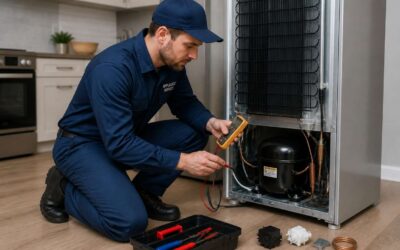
A technician in air conditioner and fridge repair checks the amp draw and coil temperature before condemning the compressor. Sometimes the unit simply needs coil cleaning and better ventilation. But when the compressor seizes, replacement is the only honest answer.
Defrost System Failures and Icy Buildup
I’ve opened fridges in Pretoria with ice so thick it scrapes the door seal. Defrost system failures cause most of this frosty chaos. When the defrost heater, timer, or bi-metal thermostat fails, the evaporator coil freezes into a solid block. Airflow chokes, temperatures climb, and the compressor runs overtime.
Common failure points I see in the field:
– A defrost timer stuck in cooling mode
– A heater element with an open circuit
– A defrost thermostat that never closes
For reliable air conditioner and fridge repair, technicians test each component in sequence. They check resistance on the heater, advance the timer manually, and measure thermostat continuity. Sometimes the fix is a simple timer replacement. Other times, the entire defrost board needs swapping.
Seal and Gasket Deterioration Leading to Air Leaks
The rubber lip on your fridge door absorbs a thousand openings a year, and most owners never give it a second thought. Yet a perished gasket is a common reason a compressor runs longer than it should. I’ve pulled worn seals from fridges in Pretoria where the magnetic strip had lost its grip entirely, leaving a visible gap once the door shut.
Heat, ozone, and harsh cleaning chemicals break down the PVC or rubber over time, creating micro-cracks that let conditioned air escape. Technicians check a seal by closing the door on a thin strip of paper. When the paper slides out with zero resistance, the gasket is done. For reliable air conditioner and fridge repair, replacing a gasket is straightforward, but the screws often hide beneath a trim strip. A poor fit leaves the new seal just as leaky as the old one.
Unusual Noises, Leaks, and Door Alignment Problems
Some refrigerators start talking to you. A low hum from the back panel might be the evaporator fan hitting a film of frost, not the compressor. Over a decade of service, I have seen door alignment problems masquerade as multiple faults. When the hinge loosens, the door drops by half a centimetre. That subtle shift lets warm air enter along the top edge, and the chilled air escapes from the bottom. The result is a constant drip under the appliance, yet the drain line is perfectly clear.
This water leak has nothing to do with the pan or the tubing. It is condensation from the contrast between warm room air and the cold interior. A technician checks the door’s geometry before touching any refrigerant. One rusted hinge screw can create that dull knocking sound you hear at night. For reliable air conditioner and fridge repair, aligning the door is often a matter of loosening the lower bracket and resetting the weight. Then the noises stop, and the floor stays dry. It is remarkable what a few minutes with a socket wrench can solve.
DIY Repair vs. Professional Service: Pros and Cons
Simple Fixes You Can Safely Do Yourself
Most cooling appliance failures begin as small, observable quirks. A rattling fan or warmth from the compressor often traces back to something simple, like a clogged vent or a loose plug. Homeowners can safely address several issues without breaching the sealed system. These tasks require basic care and common sense:
- Cleaning or replacing washable air filters monthly
- Verifying that the power cord sits firmly in its socket
- Clearing dust from the condenser coils with a soft brush
These actions reduce motor strain and often prevent unnecessary callouts. Professional expertise becomes essential when faults involve refrigerant, circuit boards, or welded lines. A technician brings diagnostic tools and safety training, while DIY attempts can void warranties and create hazards. For complex cases, schedule a certified air conditioner and fridge repair. That investment keeps appliances efficient and extends their lifespan. Know your limits. The right balance between doing and delegating saves money and protects your home.
Why Refrigerant Handling Requires Certification
According to the South African Bureau of Standards, improper handling of refrigerant gases can result in the release of substances that contribute to ozone depletion. The risk is not merely environmental. Amateur intervention often leads to compressor burnout and costly component replacement. When you attempt to open a sealed system, you expose yourself to high pressure and frigid temperatures that can cause severe injury.
The notion that a DIY approach saves money evaporates quickly when a simple repair becomes a full system replacement. Professional air conditioner and fridge repair requires diagnostic equipment and certified technicians. Local regulations mandate specific licensing for handling these volatile chemicals. Consider the variables:
– The level of training required to safely manage gas
– The proper equipment needed for evacuation and recharging
– The legal responsibility for disposal of old refrigerants
Choosing a certified expert protects your appliance, your warranty, and your household’s safety. The balance between personal effort and professional skill remains clear. Know when to step back and call for help.
Risks of Attempting Complex Electrical Repairs
Reaching for a screwdriver when the compressor trips feels like saving money, but the risk is a live circuit and a ruined board. Electrical diagnostics require meters, schematics, and the patience to trace voltage. A shorted wire can fry the motherboard, turning a small fault into a full replacement.
Consider what trained technicians check when they arrive for air conditioner and fridge repair:
- Capacitor health and start relays
- Wiring insulation and terminal connections
- Control board voltage under load
These steps prevent the silent failure that happens when a DIY fix works for a week, then fails again. Professional service costs more upfront, yet it reduces the chance of electrocution and repeated breakdowns.
Time and Cost Savings of Hiring a Certified Technician
One homeowner’s “quick fix” often becomes a technician’s second call. Weighing DIY repair against professional service reveals more than the immediate price tag. A Saturday spent watching tutorials can turn into a week without cooling, especially when the part you ordered arrives damaged. Certified technicians carry the correct components on their vans, plus the diagnostic tools to identify the root cause. Your time has value, and the hours lost troubleshooting could be spent earning money or resting.
The Professional Advantage becomes clear when you examine the warranty and liability. A licensed technician offers a workmanship guarantee. If the fault reappears, they return without a new invoice. DIY work owns no such promise. A mistake can invalidate your appliance’s factory warranty, turning a simple repair into a costly affair. For a comprehensive air conditioner and fridge repair, consider what the service fee actually covers:
– A verified diagnosis from a qualified engineer.
– Access to genuine, manufacturer approved spare parts.
– Insurance coverage for any accidental damage during the job.
– A structured report for your records.
Hiring a certified professional in South Africa also means navigating local regulations on gas handling and electrical compliance. The trade-off is simple. DIY saves on the call-out fee but risks a full replacement. Professional service costs more upfront, yet it protects the unit’s lifespan and your personal safety.
Warranty Implications of Self-Repair
One misplaced screw can void the warranty on your appliance. When homeowners choose self-repair, they accept a hidden risk. The factory warranty often requires proof of professional installation and genuine parts. In my experience, a failed DIY attempt leaves you with no recourse. In South Africa, warranty claims on refrigeration equipment hinge on certified workmanship. A licensed technician for air conditioner and fridge repair preserves your coverage. They document each step, ensuring compliance with manufacturer terms. Self-repair might appear cheaper, but the cost of a voided warranty outweighs the saved call-out fee. Consider what you lose:
- The original parts warranty
- Future service support
- Protection against fault recurrence
Professional repair maintains the unit’s value. The short-term savings vanish when you pay for a full replacement. Trust a specialist to protect both your appliance and your legal claim to coverage!
Cost Factors for Air Conditioner and Fridge Repair
Parts and Labor: How Charges Are Calculated
When you call for air conditioner and fridge repair in South Africa, the bill rarely matches the quote you imagined. Charges hinge on a mix of part prices and labour hours, and both vary wildly depending on where you live and the age of your unit. The technician’s first task is diagnosing, which carries its own fee.
Labour typically runs as a flat rate per 30 minutes, plus a travel charge. Parts carry a mark-up, often 20% to 30% above wholesale. For older refrigerators, finding a compatible component can push costs higher, making the final amount an exercise in arithmetic rather than guesswork.
- Compressor replacements: the most expensive single part
- Capacitor and fan motor swaps: moderate, but common
- Sealed system repairs: labour intensive, with added refrigerant charges
I always tell clients to ask for a written breakdown before authorising work. It protects you and sets clear expectations for the final invoice.
Average Price Ranges by Common Repair Type
The true cost of air conditioner and fridge repair in South Africa often becomes clear only after the first invoice arrives. I have seen households pay R1,200 for a simple capacitor swap while a neighbour across the road spent R8,000 on a sealed system. The difference lies in the unit’s age, the refrigerant type, and the compressor’s condition. Common repairs carry their own price ranges:
- Capacitor replacement: R700 to R1,800
- Gas recharge (R290 or R134a): R1,000 to R2,500
- Fan motor replacement: R1,500 to R3,200
- Compressor replacement: R4,500 to R9,000
Location nudges these numbers too. Urban centres like Johannesburg and Cape Town see higher call-out fees, while rural towns often surprise with lower labour rates but scarce parts. For a balanced view, always ask for a written quote. The final invoice should mirror the repair’s true shape, not a hopeful guess.
Age and Model Efficiency Impact on Repair Costs
Your refrigerator does not celebrate birthdays, but your wallet certainly feels them. Old units force repair technicians to hunt through dusty suppliers for obsolete parts. New units retaliate with inverter boards that demand specialist diagnostic gear. Both roads lead to the same air conditioner and fridge repair invoice, though the zeros differ sharply.
Efficiency ratings complicate the maths. Swapping a compressor in a 15-year-old fridge might cost R4,500, yet that unit still drains power like a small heater. A newer sealed system could set you back R8,000, but the monthly electricity bill drops enough to soften the blow. The trade-off follows a simple pattern:
- Older models: cheaper individual parts, harder to source
- Newer models: expensive electronics, widely available components
Age and efficiency write the real price before a technician even unpacks the screwdrivers.
Emergency and After-Hours Service Fees
When the compressor dies on a Friday evening, the clock becomes the most expensive component. Emergency callouts for air conditioner and fridge repair carry a premium that many households underestimate. Technicians rarely charge the same rate after hours, and the surcharge often appears as a flat fee before any diagnostic work begins.
Travel time, overtime labour, and the urgency of a warm fridge all push the invoice upward. Some companies apply a minimum charge for after-hours visits, while others scale the fee based on the time of night.
- A standard callout fee covers business hours and a set travel radius.
- An emergency surcharge typically adds 50% to 100% to the base labour rate.
- Public holidays and Sundays may trigger an additional multiplier.
The total bill depends on the hour and the fault. In South Africa, those midnight breakdowns leave households weighing speed against cost.
Preventive Maintenance to Reduce Future Repair Needs
Monthly Cleaning and Filter Replacement Schedules
Most breakdowns don’t happen suddenly. They announce themselves through small inefficiencies, unnoticed for months. A compressor that runs a little longer each day. By the time the unit fails, the damage has compounded. Preventive maintenance matters, especially for air conditioner and fridge repair costs in South Africa.
Monthly cleaning comes first. Dust and grime accumulate on condenser coils, forcing the system to work harder. Filter replacement follows a similar rhythm. A clogged filter restricts airflow and strains the system. For fridges, clean the condenser coils. For air conditioners, replace filters every four to six weeks.
A monthly checklist covers the essentials:
- Vacuum condenser coils
- Replace or wash air conditioner filters
- Check fridge door seals
Skipping these small tasks leads to bigger problems. The result is an expensive air conditioner and fridge repair call that could have been avoided with twenty minutes of routine care. I’ve seen it too often!
Seasonal Checkups for Air Conditioners
Seasonal checkups for air conditioners prevent the most expensive failures. In South Africa, the cooling season arrives quickly. A professional inspection before the heat builds can catch worn capacitors, failing fan motors, and refrigerant pressure issues while they are still inexpensive to address. This is where air conditioner and fridge repair costs are truly controlled. A technician who checks your system twice a year spots the slow deterioration that monthly cleaning cannot reveal.
For fridges, the same logic applies. A fridge runs year round, so its seasonal rhythm is less obvious. Still, a pre-summer check of the compressor and thermostat ensures the unit is ready for the warmer months when it will work harder.
A seasonal inspection should cover:
– Electrical connections and contactors
– Refrigerant levels and pressure readings
– Fan blade alignment and motor lubrication
– Drain pan and condensate line condition
These checkups reduce the likelihood of emergency air conditioner and fridge repair calls during peak season.
Proper Food Storage and Airflow for Refrigerators
The arrangement of groceries inside your refrigerator determines how often the compressor switches on. A blocked supply vent forces cold air back toward the evaporator coil, which lowers efficiency and causes short cycling. I have seen a single misplaced pot roast shorten a compressor’s lifespan!
- Keep vent slots clear of containers and packaging
- Allow a finger’s width between items
- Cool cooked food before placing it inside
- Remove expired items that crowd the shelves
These actions keep internal air moving and reduce frost buildup on the evaporator. Better airflow means the thermostat reads actual cabinet temperature instead of trapped pockets of cold air. The result is fewer hard cycles and a lower chance of premature failure. Preventive maintenance of this kind directly lowers your total spend on air conditioner and fridge repair, because the same airflow logic applies to both appliances.
Monitoring Temperature and Energy Consumption
A refrigerator runs for years on a steady cycle. Then one day the compressor stops, leaving a warm cupboard and a hefty invoice. Monitoring temperature and energy consumption catches small problems before they become costly air conditioner and fridge repair.
A fridge that drifts two degrees warmer than its setting often indicates a failing seal or clogged condenser. A sudden spike in electricity usage points to a compressor working overtime. Track both weekly. I have seen a notebook save homeowners thousands of rand because it made them notice inefficiency developing slowly.
- Keep a thermometer inside the fridge cabinet
- Compare electricity bills against the same period last year
- Note the compressor cycle length
Those three habits cost nothing. They reveal the gradual decline of appliance performance, and they cut down on future air conditioner and fridge repair needs. A compressor running ten minutes longer per cycle wastes significant energy each month.
Signs That Indicate It’s Time to Replace Instead of Repair
Every machine has a breaking point. The dilemma of repair versus replacement lurks behind every failed compressor, every rattling condenser. Preventive maintenance is the art of stalling that moment of reckoning. A quarterly dusting of the condenser coils, a careful cleaning of the fan blades, these small rituals extend the life of your units. They are the difference between a minor adjustment and a major overhaul. For homeowners in South Africa, where heat demands constant cooling, these habits matter. They delay the inevitable, but they also make the inevitable more affordable when it arrives.
There comes a time when the cost of saving outweighs the cost of replacing. A compressor failure in a unit over ten years old signals the end. The repair bill might equal half the price of a new, energy efficient model. When the cabinet rusts from the inside, when the refrigerant is R22, a chemical being phased out, replacement becomes the only logical choice. Consider these signs:
– The appliance is older than ten years and requires frequent air conditioner and fridge repair calls.
– The repair estimate exceeds fifty percent of the replacement cost.
– The energy rating of the old model is far inferior to modern standards.
Deciding to replace is not an admission of defeat. It is an investment in lower electricity bills and fewer future headaches. A single, well timed purchase beats years of sporadic, costly patches. Every repair is a gamble. Sometimes you win a few more months, sometimes you lose the money outright. Know when to walk away from the old machine and embrace the new one.


0 Comments